
Recessed and Under-Cabinet Lighting: Fixing a Dark Room Before Winter
Why does my house feel so dark in the fall?
Because it is. In northern New Jersey, daylight drops from roughly 15 hours in late June to about 9 hours by December. Rooms that felt fine all summer suddenly need their lights on by mid-afternoon, and lighting that was merely adequate starts to feel genuinely inadequate.
Every year around this time we get calls from homeowners in Wayne and across Passaic County who have finally had enough of a dim kitchen or a living room with one sad ceiling fixture. Here’s what actually fixes it.
What’s wrong with the lighting I already have?
Most older Wayne homes were built with a single overhead fixture per room, sometimes a switched outlet and nothing else. That design assumes you’ll fill in the gaps with lamps.
The result is a room lit from one point in the ceiling. You get a bright spot in the middle, shadows at the edges, and your own body blocking the light whenever you lean over a counter or a work surface. It’s not that the bulb isn’t bright enough. It’s that light coming from one place can’t do the job of light coming from several.
What are the three layers of good lighting?
Lighting designers think in three layers, and it’s a genuinely useful way to diagnose a room:
- Ambient is the general fill that lets you move around safely. Recessed cans, a ceiling fixture, or a fan light.
- Task is light aimed where you actually do things. Under-cabinet lighting over a counter, a pendant over an island, a fixture over a desk or workbench.
- Accent is what makes a room feel finished rather than merely lit. Wall sconces, picture lights, toe-kick or cove lighting.
A room that feels dark almost always has ambient light only. Adding task lighting usually changes how a space feels more than adding more ceiling cans would.
What lighting upgrades actually make a difference?
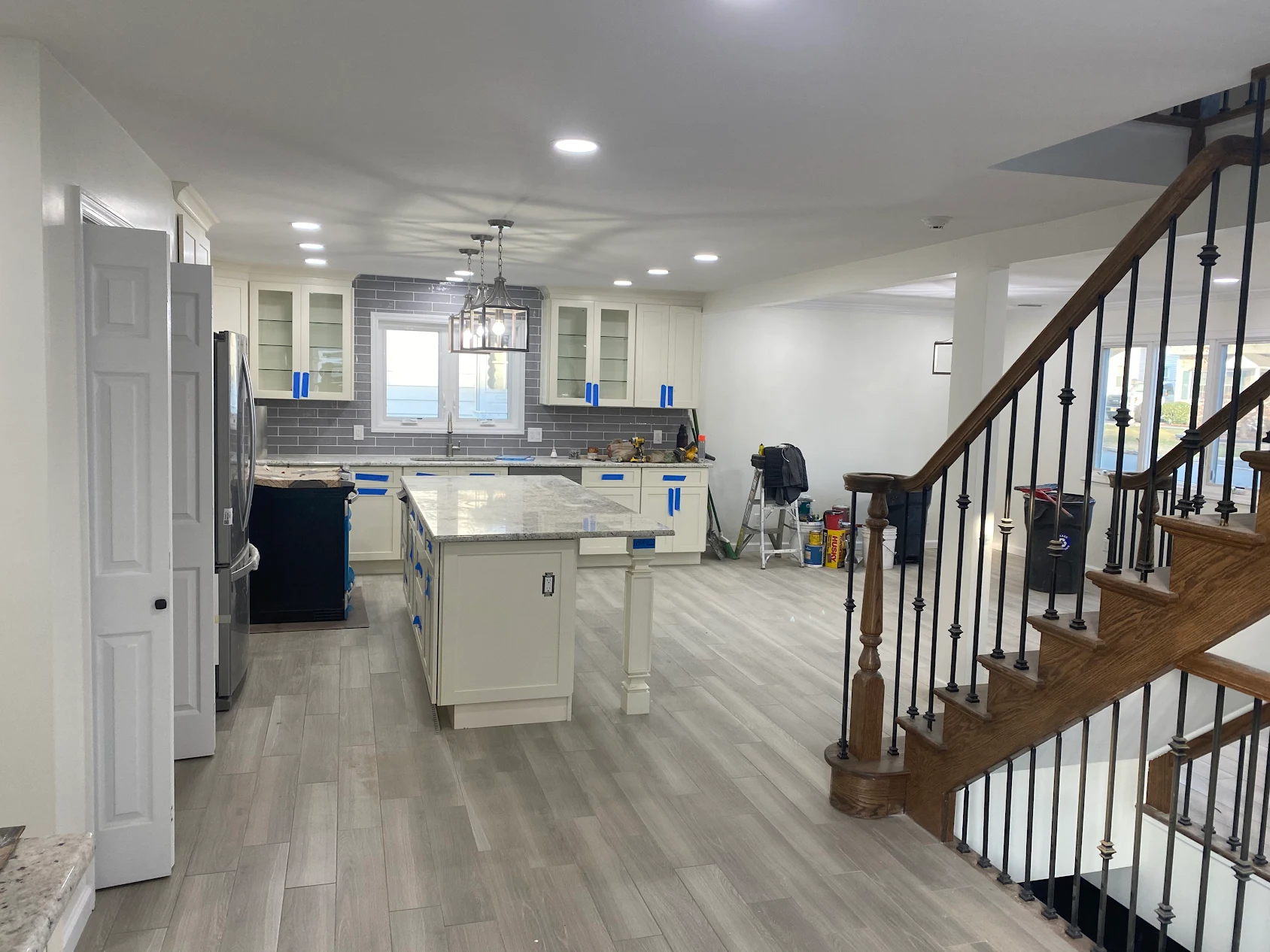
Recessed lighting. The most requested upgrade we do, and the one that transforms a dim room fastest. Properly spaced cans replace that single central fixture with even coverage across the whole room. Modern LED units are shallow enough to fit in tight ceiling cavities that used to rule them out.
Under-cabinet lighting in the kitchen. Pound for pound the highest-impact upgrade in most homes. Your countertop is where you actually work, and it’s precisely the surface your own shadow falls across when the only light is overhead.
Dimmers. Cheap, fast, and consistently underrated. The same fixture at full brightness for cooking and dimmed for dinner is effectively two different rooms. Worth noting: dimmers must be compatible with LED loads, and a mismatch is the usual culprit behind buzzing or flickering.
Pendants over an island or sink. Task light and visual anchor at once.
Closet, pantry, and basement stair lighting. Unglamorous and frequently overlooked. These are the spots where people use their phone flashlight for years without thinking to fix it.
See our lighting installation page for the full range of what we handle.
How many recessed lights does a room need?
There’s a rough starting point, but it’s a starting point rather than a rule. General guidance spaces cans a distance apart roughly equal to half the ceiling height, so a room with an 8-foot ceiling might have lights on a 4-foot grid.
What actually shifts the number: ceiling height, how dark the walls and floors are (dark finishes absorb a lot of light), what the room is used for, and whether task lighting is carrying part of the load. A kitchen needs materially more light than a bedroom of the same size.
Over-lighting is a real mistake too. A ceiling covered in cans on a single switch looks like an office. Zoning the lights across multiple switches and adding dimmers is usually a better answer than simply adding more.
What color temperature should I choose?
This is where people most often regret their choice, and it costs nothing to get right up front.
Color temperature is measured in Kelvin. Lower numbers are warmer and yellower, higher numbers cooler and bluer. Around 2700K is warm and traditional, similar to old incandescent bulbs. 3000K is slightly crisper and very common in kitchens and baths. 4000K reads as neutral to cool and suits garages, workshops, and laundry rooms. Anything above that starts feeling clinical in a living space.
The single most important thing is consistency. Mixed color temperatures in one sightline look wrong even when people can’t articulate why. If your kitchen cans are 3000K, the under-cabinet lights and pendants should match.
Also worth asking about CRI, or color rendering index. Higher CRI means colors look truer, which matters more than most people expect in a kitchen where you’re judging whether food is cooked.
Can recessed lighting be added without tearing up my ceiling?
In many cases, yes. Remodel-style housings are designed to install into an existing finished ceiling, and the wiring can often be fished through the cavity from a nearby fixture or an accessible attic space.
How cleanly it goes depends on what’s above the ceiling. An accessible attic makes it straightforward. A finished second floor above means working entirely within the ceiling cavity, which is still very doable but requires more care. Plaster ceilings in older homes need a gentler approach than drywall.
We look at the space and tell you honestly what access we’ll need before starting, rather than discovering it halfway through.
Does new lighting require a permit in New Jersey?
Adding new circuits or new lighting outlets is permitted electrical work in New Jersey and requires inspection. Directly swapping an existing fixture for a new one generally does not.
Since a recessed lighting project usually means new outlets, new switching, and sometimes a new circuit, expect a permit to be part of the job. As your licensed electrical contractor, we pull it and meet the inspector.
Frequently asked questions
How long does a recessed lighting installation take?
A single room is frequently a one-day job. Larger projects or difficult ceiling access take longer. We give you a timeline after seeing the space.
Can I put recessed lights in a sloped or cathedral ceiling?
Yes. Sloped-ceiling housings and adjustable trims exist specifically for this, and gimbal trims let you aim the light rather than pointing it straight down.
Why do my LED lights flicker or buzz?
Usually an incompatible dimmer. LEDs draw far less current than the incandescent bulbs older dimmers were designed for. An LED-compatible dimmer normally solves it.
What size recessed lights should I use?
Four-inch and six-inch are the common residential sizes. Smaller units suit tighter spaces and more contemporary looks; six-inch covers more area per fixture.
Do I need a separate switch for under-cabinet lighting?
Almost always worth it. The whole point is being able to run counter lighting independently of the ceiling.
Can you add lighting to a room with no ceiling fixture at all?
Yes. It means running new wiring and adding switching, and it’s a common request in older homes and finished basements.
Is it worth upgrading to LED if my fixtures still work?
Usually. LEDs use substantially less energy and last far longer, and the light quality from current LED products is dramatically better than early generations.
Can you install lighting and a ceiling fan on the same project?
Yes, and it’s efficient to combine them. Our ceiling fan installation page covers that work.
Serving Wayne and Passaic County
Luminous Electric LLC is a licensed and insured New Jersey electrical contractor based at 586 Valley Rd in Wayne. We install recessed lighting, under-cabinet lighting, pendants, sconces, dimmers and ceiling fans throughout Wayne, Pompton Lakes, Little Falls, Totowa, Clifton, Passaic, Paterson, West Milford and Ringwood, plus neighboring Bergen, Essex and Morris counties. 4.9 stars across 122 Google reviews.
If a room in your house has been bothering you for a while, now is the time to deal with it, before the short days arrive. Get in touch and we’ll take a look.
Luminous Electric LLC
NJ Lic. #17641 — Licensed Electrical Contractor
Headquarters: 586 Valley Rd, Wayne, NJ 07470 | Phone: (973) 777-9202
Proudly serving homeowners and commercial properties across Passaic, Bergen, Essex, and Morris Counties.